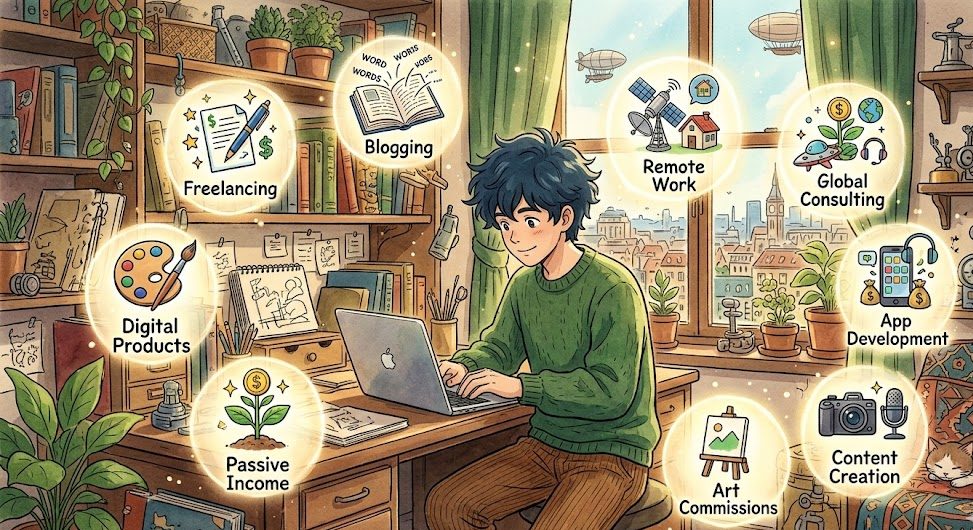
Did you know that by the start of 2026, the global remote workforce is projected to encompass nearly 45% of all professional roles? The days of the traditional 9-to-5 being the only path to financial security are officially behind us. However, for many, the “make money online” space feels like a digital minefield filled with “get-rich-quick” schemes and outdated advice.
The challenge isn’t a lack of opportunities; it’s the overwhelming noise of the digital age. How do you distinguish a sustainable career path from a fleeting trend? This article serves as your definitive roadmap. We will strip away the fluff to reveal 25 legitimate, beginner-friendly strategies that are actually working in 2026. From leveraging AI-enhanced creativity to the booming “human-centric” service economy, you are about to learn exactly how to build a digital income stream from scratch.
Understanding Online Income: Key Concepts and Importance
Making money online is no longer about “tricking” an algorithm; it is about value exchange. Think of the internet as a massive, global marketplace that never sleeps. In the past, earning digitally required deep coding knowledge or significant capital. Today, the “No-Code” revolution and AI integration have leveled the playing field, making it possible for anyone with a laptop and a solid work ethic to compete.
To understand the modern digital economy, think of it like a digital real estate market. Some people “rent” out their time (freelancing), some “build” assets that appreciate (blogs or YouTube channels), and others “flip” products for a profit (e-commerce). The modern relevance of online work lies in its flexibility and resilience. While local economies may fluctuate, the global digital market provides a buffer, allowing you to earn in stronger currencies or tap into industries that are thriving halfway across the world.
Why It Matters: The Top Benefits of Digital Earning
Transitioning to an online income model isn’t just about the paycheck; it’s about a fundamental shift in lifestyle and security.
- Location Independence: Work from a home office, a local café, or a different country. Your geography no longer dictates your salary.
- Scalability: Unlike a physical job where you are paid for 1-to-1 hours, digital products (like courses or e-books) allow you to sell to thousands of people simultaneously.
- Lower Overhead Costs: Starting a traditional brick-and-mortar business costs thousands. Starting a freelance career or a niche site often costs less than a monthly gym membership.
- Skill Diversification: The online world moves fast. By working digitally, you naturally pick up high-demand skills like data literacy, digital marketing, and AI prompting.
Pro Fact: According to recent 2026 labor statistics, “Portfolio Careers”—where individuals hold 3-4 different online income streams—have increased by 30% since 2023, providing higher financial stability than single-employer roles.
How to Get Started: A Practical Guide for Beginners
Ready to dive in? Here are 25 legit ways categorized by “effort vs. reward,” followed by your 5-step implementation plan.
The 25 Legit Ways for 2026
- AI Prompt Engineering: Helping businesses optimize their AI outputs.
- Ghostwriting for LinkedIn: Building personal brands for busy executives.
- UGC (User Generated Content) Creator: Making “authentic” video ads for brands.
- Niche Newsletter Publishing: Curating specific industry news via Substack.
- Virtual Assistant 2.0: Handling complex tasks like CRM management and AI scheduling.
- E-commerce Reselling: Sourcing unique items for platforms like Poshmark or eBay.
- Online Tutoring: Teaching specialized skills (not just academics) via Zoom.
- Digital Product Sales: Selling Notion templates, Planners, or Budget trackers.
- Affiliate Marketing: Recommending products you love and earning a commission.
- Podcast Editing: Cleaning up audio and creating “show notes” for creators.
- SEO Writing: Crafting content that ranks on search engines.
- YouTube Faceless Channels: Creating educational content using stock footage and AI voiceovers.
- Social Media Management: Running TikTok or Instagram accounts for local businesses.
- Transcription Services: Specialized legal or medical transcription.
- Website Testing: Providing feedback on user experience for new apps.
- Voiceover Work: Using platforms like Upwork to find commercial gigs.
- Data Entry & Cleanup: Helping AI companies “label” data for machine learning.
- Print-on-Demand: Designing t-shirts or mugs without holding inventory.
- Remote Bookkeeping: Managing finances for small startups.
- Online Language Coaching: Conversational practice for ESL learners.
- Stock Photography/Video: Selling your high-quality b-roll to sites like Adobe Stock.
- Community Management: Moderating Discord or Slack communities for brands.
- Translation Services: Real-time or document translation.
- Curated Subscription Boxes: Designing the concept for others to fulfill.
- Micro-SaaS Founder: Using “No-Code” tools to build a simple app that solves one specific problem.
5-Step Action Plan
- Identify Your “High-Value” Skill: Look at what you are already good at (writing, organizing, or talking) and match it to the list above.
- Build a “Minimum Viable Portfolio”: You don’t need a fancy website. A simple PDF or a LinkedIn profile showing 3 examples of your work is enough.
- Choose Your Platform: Select one “home base”—Upwork for freelancing, Shopify for sales, or X/LinkedIn for networking.
- Set a “Power Hour”: Commit to 60 minutes of focused work every day. Consistency beats intensity in the digital world.
- Validate and Pivot: Try your first method for 30 days. If you see zero traction, analyze why, and don’t be afraid to pivot to a different method on the list.
Beginner’s Tip: Avoid “Shiny Object Syndrome.” Pick one method and stick with it until you earn your first $100 before trying a second one.
Overcoming Challenges and Looking into the Future
The biggest hurdle for beginners in 2026 is Digital Fatigue. With so many people working online, “standing out” requires a human touch. Automated AI content is everywhere; therefore, content that shows personality and lived experience is actually more valuable than ever.
Another challenge is the Security Gap. As you move online, cybersecurity becomes your responsibility. Use password managers and two-factor authentication for every platform you use to earn money. Looking ahead, the trend is moving toward the “Creator Economy 3.0,” where niche communities and micro-influencers hold more power than massive, faceless corporations. Personal branding isn’t just an ego boost; it’s your insurance policy against automation.
Conclusion
The transition to earning online is a marathon, not a sprint. By focusing on providing genuine value—whether through a service, a product, or your unique perspective—you can build a sustainable income that offers more than just money: it offers freedom.
The year 2026 is brimming with opportunity for those brave enough to start. Your first step? Pick one item from the list of 25 and spend the next hour researching how to create your first “demo” or “sample” in that niche.
Your future self will thank you for the work you start today. The digital door is open—walk through it.
FAQs
1. Do I need a degree to make money online in 2026? No. Most online clients and platforms prioritize your portfolio and proven results over formal education. Skills like AI prompting and digital marketing are often learned through online certifications and practice.
2. How much money can a beginner realistically make? While it varies, many beginners earn between $500 and $2,000 per month within their first 3-6 months of consistent effort. High-skill roles like Prompt Engineering or SEO Writing can scale much higher.
3. Is it too late to start a YouTube channel or Blog? Absolutely not. While broad topics are crowded, “Hyper-Niche” content (e.g., “Gardening for High-Altitude Balconies”) is still underserved and highly profitable.
4. Are these methods “passive income”? Most start as active income (trading time for money). However, things like digital products, affiliate marketing, and YouTube can eventually become passive once the initial work is done and the system is automated.