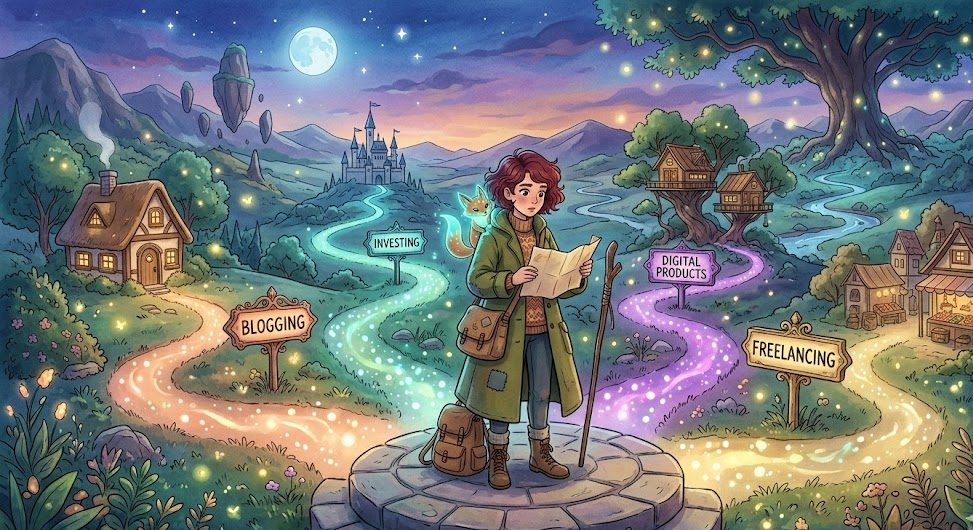
If you earned money while you slept last night, how would your stress levels change this morning? It is a startling reality that the average millionaire has at least seven different streams of income. Yet, most of the global workforce relies on just one: a physical paycheck tied directly to their time. In an era of rapid inflation and AI-driven job displacement, relying on a single source of income isn’t just risky—it’s a financial gamble you can no longer afford to take.
The primary challenge most people face is the “Time-for-Money Trap.” We are taught that to earn more, we must work more hours, but time is a finite resource. This creates a ceiling on your wealth and a floor on your exhaustion. The ultimate solution is Passive Income Architecture—the process of building systems today that generate cash flow tomorrow without your direct, daily involvement. This guide serves as your professional blueprint for 2026. We will deconstruct the myths of “effortless wealth” and provide a realistic, step-by-step roadmap to building a diversified portfolio of income streams that work as hard as you do.
Understanding Passive Income: Key Concepts and Importance
Passive income is often misunderstood as “free money,” but in 2026, it is more accurately described as Deferred Reward for Upfront Effort. Historically, passive income was reserved for the landed gentry or wealthy investors with access to the stock market and real estate. Today, the digital revolution has democratized this concept, allowing anyone with a computer to build digital assets that yield recurring revenue.
Think of building passive income like planting an orchard. In the beginning, you must clear the land, plant the seeds, and water the saplings daily. This is the “active” phase where you work for no immediate pay. However, once the trees reach maturity, they produce fruit season after season with only minimal pruning. In technical terms, you are moving from Linear Income (where $Work \times Time = Pay$) to Leveraged Income (where $Initial Work \times Scalable System = Recurring Pay$). This modern relevance is vital because it provides a “Financial Shock Absorber” against economic volatility.
Why It Matters: The Top Benefits of Multiple Income Streams
Diversifying your income isn’t just about luxury; it’s about fundamental personal and economic security.
- Risk Mitigation: If one “engine” of your income stalls—such as a job loss or an industry downturn—the other streams keep your financial ship afloat.
- Compounding Wealth: Passive streams allow you to reinvest earnings back into new assets, creating a “snowball effect” that accelerates your path to financial independence.
- Time Freedom: The ultimate goal of passive income is to decouple your survival from your schedule, allowing you to spend time on what truly matters: family, health, and passion projects.
- Geographic Independence: Most passive streams in 2026 are digital, meaning they pay you regardless of where you are in the world, unlinking your earnings from local economic conditions.
Pro Fact: According to 2026 wealth management data, individuals with three or more passive income streams are 70% less likely to report significant financial stress during inflationary periods than those with a single income source.
How to Get Started: A Practical Guide for Beginners
Building an income empire doesn’t happen overnight. It requires a systematic approach to asset creation. Follow this 5-step actionable plan to begin.
1. The Audit and Allocation Phase
Determine what you can invest: Capital (money) or Sweat Equity (time). If you have $0, you must start by building digital assets (blogs, YouTube, or e-books). If you have savings, you can start with dividend stocks or real estate syndications.
2. Choose Your First “Vessel”
Pick one stream and master it before moving to the next. High-performing options in 2026 include:
- Dividend Growth Investing: Buying shares in companies that pay you a portion of their profits.
- Digital Content Assets: Creating a niche newsletter (Substack) or an automated YouTube channel.
- Rental Arbitrage: Using platforms like Airbnb to manage properties you don’t necessarily own.
- SaaS and Apps: Using “No-Code” tools to build a simple subscription-based app.
3. Build the “Minimum Viable Asset”
Don’t wait for perfection. If you are writing an e-book, get the first three chapters done and set up a pre-order page. If you are investing, start with Index Funds to capture market growth immediately.
4. Automate the Operations
Use tools like Zapier or Make.com to connect your platforms. For example, if you sell a digital product, automate the delivery, the receipt, and the follow-up email marketing so you never have to touch a manual “send” button.
5. The “Harvest and Reinvest” Cycle
Once your first stream produces $100 a month, do not spend it. Use that $100 to fund the tools or capital needed for your second stream. This is how you build a “Multiple Stream” architecture without needing a massive initial investment.
Beginner’s Tip: Beware of “High-Yield” scams. If a platform promises “guaranteed” returns of more than 1% per day, it is almost certainly a Ponzi scheme. Real passive income is tied to real value or real assets.
Overcoming Challenges and Looking into the Future
The biggest hurdle for beginners is Front-Loaded Friction. It is psychologically difficult to work for three months on a project that hasn’t paid a cent yet. To overcome this, focus on “micro-milestones” rather than the final dollar amount. Another challenge is Asset Decay; even passive income requires “pruning” or occasional updates to remain relevant in a shifting market.
Looking toward 2027 and beyond, the trend is moving toward Fractional Ownership. You can now own 1% of a commercial building or 5% of a valuable painting through blockchain-verified platforms. This allows you to build a diversified portfolio with much smaller amounts of capital than was previously possible. AI will also play a larger role, acting as a “Digital Manager” that automatically rebalances your portfolios and optimizes your ad spend in real-time.
Conclusion
Building multiple streams of passive income is the only way to truly “buy back” your future. It is a transition from being a participant in the economy to being an architect of it. While the initial climb is steep, the view from the top—where your expenses are covered by assets rather than effort—is worth every hour of upfront labor.
Your task for today: Identify one “Active” skill you have and brainstorm how to turn it into a “Passive” asset (e.g., if you are a teacher, could you create a $20 downloadable lesson plan?).
The best time to plant your income orchard was ten years ago; the second best time is today.
FAQs
1. How much money do I need to start building passive income?
You can start with $0 if you invest your time into creating digital assets like blogs, niche social media accounts, or YouTube channels. If you prefer investing in stocks or real estate, you can start with as little as $10–$50 using fractional investing apps.
2. Is passive income really 100% “hands-off”?
No. Most streams are 90% passive. You will always need to spend a few hours a month or year “pruning” your assets—checking your portfolio, updating an e-book, or responding to high-level inquiries.
3. How long does it take to replace a full-time salary?
For most people, it takes 2 to 5 years of consistent effort to build enough passive income to replace a standard 9-to-5 salary. It is a marathon, not a sprint.
4. What is the safest passive income stream for beginners?
High-Yield Savings Accounts (HYSA) and Low-Cost Index Funds (like the S&P 500) are generally considered the safest and easiest starting points for those with some capital.