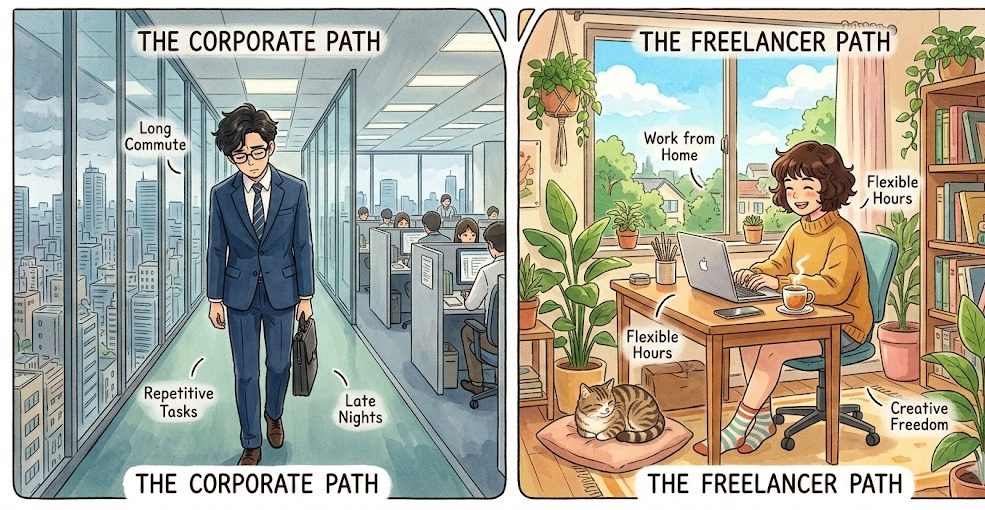
Did you know that by the end of 2026, it is projected that over 90 million Americans will have engaged in freelance work, making up nearly 50% of the total workforce? The traditional “9-to-5” is no longer the default setting for a successful career. We are living in an era where the boundary between a “stable” job and a “flexible” hustle has blurred. Many professionals now face a paralyzing dilemma: should they stick with the guaranteed paycheck and benefits of a full-time role, or leap into the high-reward, high-autonomy world of freelancing?
The challenge lies in the illusion of security. Many full-time employees realize their “stable” jobs are susceptible to AI-driven restructuring, while many freelancers struggle with the “feast or famine” cycle. The pain point is no longer just about money; it’s about sovereignty over time. The ultimate solution isn’t necessarily choosing one over the other forever, but understanding which model aligns with your current life stage and financial goals. This article serves as a comprehensive roadmap to help you navigate this choice, analyzing the economic shifts of 2026 and providing a tactical guide to transitioning between these two worlds.
Understanding the Shift: Key Concepts and Importance
In 2026, the debate of “Freelancing vs. Full-Time Job” is less about the work itself and more about the Employment Architecture. A full-time job is a centralized model: you sell 40+ hours of your week to a single entity in exchange for a package that includes a salary, health insurance, and retirement contributions. Freelancing, conversely, is a decentralized model: you operate as a “Business of One,” selling specialized outputs to multiple clients.
To understand the technical difference, think of a Power Grid vs. Solar Panels. A full-time job is like being connected to the city’s power grid. It’s reliable and easy to set up, but if the grid goes down (layoffs), you are in the dark. Freelancing is like having your own solar panels. It takes more work to install and maintain, and you have to manage your own storage (savings), but you are energy-independent. In 2026, the relevance of this choice is at an all-time high because Digital Infrastructure—like AI assistants and global payment platforms—has made “installing your own solar panels” easier than ever before.
Why It Matters: The Top Benefits of Each Model
Both paths offer distinct advantages. Your choice depends on whether you value a high floor (security) or a high ceiling (growth).
Benefits of Freelancing (The Freedom Model)
- Income Unlimited: You are not restricted by a yearly salary increase. If you become twice as fast using AI tools, you can handle twice the clients and effectively double your hourly rate.
- Geographic Arbitrage: You can earn in a “strong” currency (like USD) while living in a “low-cost” country, significantly increasing your quality of life.
- Tax Advantages: In many regions, freelancers can deduct business expenses (home office, equipment, travel) from their taxable income, which is a luxury full-time employees rarely have.
Benefits of Full-Time Jobs (The Security Model)
- Structured Benefits: Employers in 2026 have doubled down on “Wellness Packages,” including comprehensive mental health care, parental leave, and high-match retirement funds.
- Social Capital: Full-time roles provide an instant community and professional network, reducing the “digital isolation” that often plagues independent workers.
- Cognitive Ease: You don’t have to spend 30% of your time on marketing, invoicing, or hunting for the next project. You can focus 100% on your actual craft.
Pro Fact: According to the 2026 Workforce Dynamics report, “Fractional Employment”—where a worker holds a part-time role with benefits while freelancing on the side—has become the fastest-growing employment category for Gen Z and Millennials.
How to Get Started: A Practical Guide for Beginners
Whether you are moving toward a job or toward independence, you need a transition plan. Follow this 5-step actionable roadmap:
Step 1: The Financial Audit
Before leaving a job for freelancing, build a “Runway” of at least 6 months of expenses. If moving from freelancing to a job, calculate your “Total Compensation” requirements, including the cost of lost tax deductions.
Step 2: Skill-Stacking for 2026
In both models, you must be “AI-Fluent.” Learn to use generative tools for your specific niche (e.g., GitHub Copilot for devs, Jasper for writers, or Midjourney for designers). This makes you an “Elite Producer” in either camp.
Step 3: Build a “Hybrid” Bridge
Don’t quit your day job on a whim. Start a Side-Hustle first. Aim to reach 25% of your current salary in freelance income before considering a full-time transition. This proves your skills are marketable.
Step 4: Master the Tools
- For Freelancers: Set up Loom for client updates, Bonsai for contracts, and Wise for international payments.
- For Job Seekers: Use LinkedIn Premium to identify “Remote-First” companies that offer the flexibility of freelancing with the security of a paycheck.
Step 5: The “Trial Run”
Take a two-week “workation.” If you are a freelancer, try working a structured 9-5 for a client. If you are an employee, take your vacation time to fulfill a freelance contract. Observe where your energy thrives.
Beginner’s Tip: Avoid the “All-or-Nothing” trap. Many professionals in 2026 are finding success in “Portfolio Careers,” where they have one stable part-time contract (20 hours/week) and use the rest of their time for high-stakes freelance projects.
Overcoming Challenges and Looking into the Future
The biggest challenge for freelancers in 2026 is Administrative Burnout. To solve this, you must automate your “back office” using AI-driven bookkeeping and scheduling. For full-time workers, the challenge is “Skill Atrophy.” To solve this, you must spend at least 5 hours a week learning skills outside of your current company’s requirements to stay “market-ready.”
Looking into the future, we see the rise of DAOs (Decentralized Autonomous Organizations) and Talent Collectives. By 2028, freelancers will likely belong to digital “unions” that provide group health insurance and collective bargaining power, removing the biggest downside of independent work. The future of work isn’t a choice between a boss and no boss; it’s about choosing your level of risk.
Conclusion
The “better” path in 2026 is entirely subjective. If you crave a predictable environment where you can master a single craft alongside a team, a Full-Time Job remains a powerful vehicle for success. However, if you value autonomy, location freedom, and the ability to scale your income based on your own efficiency, Freelancing is the ultimate frontier.
Your next step: Take a piece of paper and draw two columns. List your “Non-Negotiables” (e.g., “I need to pick my kids up at 3 PM” or “I need a guaranteed $5k/month”). Whichever model checks the most boxes is your winner for this year.
Whether you choose the grid or the solar panels, ensure you are the one holding the switch.
FAQs
1. Is freelancing riskier than a full-time job in 2026? It depends on how you define risk. A full-time job has a “single point of failure” (one boss). Freelancing has “diversified risk” (multiple clients). Many now argue that having five clients pay you $1,000 each is safer than one boss paying you $5,000.
2. Can I get health insurance as a freelancer? Yes. In 2026, many professional platforms (like Catch or Stride) and freelance “unions” offer portable benefits packages that are specifically designed for independent workers.
3. Do companies still hire full-time remote workers? Absolutely. While some firms have returned to the office, “Remote-First” is a dominant culture for tech, marketing, and design firms that want to access global talent without paying for expensive city real estate.
4. How do I explain a “Freelance Gap” on my resume when applying for a full-time job? Don’t call it a “gap.” List it as “Self-Employed: [Your Skill] Consultant.” Highlight your ability to manage projects, handle finances, and deliver results for diverse clients. It shows leadership and initiative.