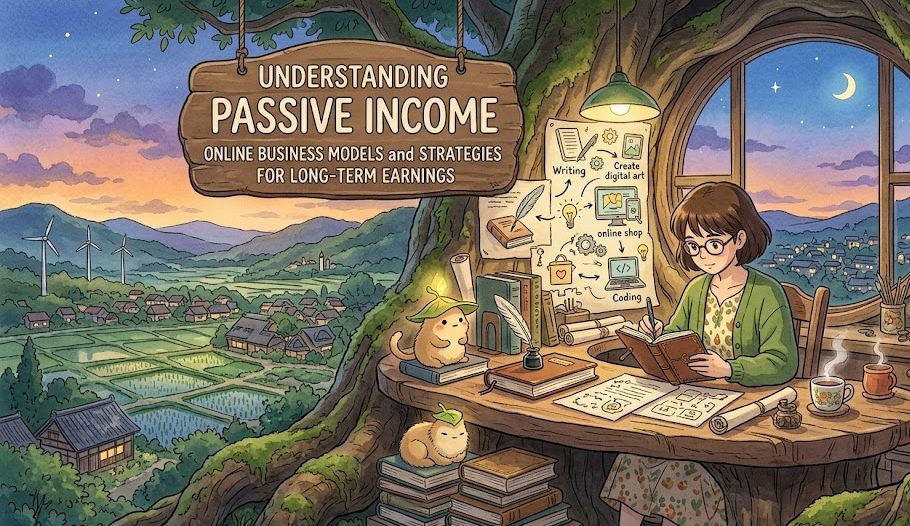
Passive income is often described as money earned without actively working for every dollar. While that description is attractive, it can create unrealistic expectations. Most genuine passive-income businesses require significant work during the setup stage and continued maintenance afterward.
A better way to understand passive income is to think of it as building an asset or system that can continue generating revenue with less day-to-day involvement than a traditional job or service business.
Online businesses have made this approach more accessible. Websites, digital products, educational resources, affiliate businesses, software tools, memberships, and content libraries can potentially generate income after they have been created.
However, no online model guarantees earnings. Results depend on factors such as demand, competition, quality, marketing, operating costs, platform rules, and the amount of work invested.
What Passive Income Actually Means
Active income generally requires direct participation. A freelancer, for example, may receive payment after completing a project. If the freelancer stops accepting projects, the income usually stops as well.
Passive or semi-passive income works differently.
The owner creates an asset, system, or business process that can continue producing revenue without requiring the same amount of active effort for every transaction.
For example, consider a digital template.
Creating the template might take several hours. Once it is listed on an online marketplace or website, multiple customers may be able to purchase it without the creator rebuilding the product each time.
The initial work is active, while later sales may require less involvement.
This is why many online income models are better described as semi-passive rather than completely passive.
The Main Types of Online Passive-Income Models
There is no single passive-income strategy that works for everyone. Different models require different combinations of skills, capital, maintenance, and marketing.
| Business Model | Initial Work | Ongoing Work | Common Revenue Source |
|---|---|---|---|
| Content website | High | Medium | Advertising, affiliates |
| Digital products | Medium–High | Low–Medium | Product sales |
| Affiliate website | High | Medium | Commissions |
| Online course | High | Low–Medium | Course sales |
| Software or SaaS | Very high | High | Subscriptions |
| YouTube/content library | High | Medium | Ads, sponsors, affiliates |
| Membership website | High | Medium–High | Recurring subscriptions |
| Print-on-demand | Medium | Medium | Product margins |
The table illustrates an important point: less active work later usually requires more work earlier.
Content Websites
A useful website can become a long-term digital asset.
A website might publish tutorials, guides, educational resources, comparisons, calculators, hobby information, or other useful content.
Revenue can potentially come from:
- Display advertising
- Affiliate partnerships
- Sponsored content
- Digital products
- Lead generation
- Memberships
- Services
The biggest advantage is that useful pages can continue attracting visitors after publication.
However, websites are not maintenance-free. Information can become outdated, search rankings can change, competitors can publish better resources, and technical problems can occur.
Successful website owners therefore treat content as an asset that needs periodic improvement.
Affiliate Marketing
Affiliate marketing is another common online business model.
A website or content creator recommends products or services and receives a commission when qualifying customers purchase through tracked links.
For example, a website about home technology might publish an article explaining how to choose a Wi-Fi router. It could include relevant affiliate links where appropriate.
The most valuable affiliate content usually helps people make informed decisions rather than simply displaying promotional links.
Useful formats include:
- Product comparisons
- Buying guides
- Tutorials
- Reviews based on genuine experience
- Product-use explanations
- Problem-solving guides
Affiliate income can fluctuate because commissions, product prices, search traffic, and program terms can change.
For this reason, building an audience around useful information is generally more sustainable than relying on a single product or affiliate program.
Selling Digital Products
Digital products are particularly interesting for people who want a scalable online business.
Possible products include:
- Spreadsheet templates
- Printable planners
- Business forms
- Educational worksheets
- Design templates
- Digital guides
- Checklists
- Presentation templates
- Photography resources
- Website resources
A digital product can potentially be sold repeatedly without manufacturing or shipping a physical item.
The challenge is creating something people actually want.
Before spending weeks building a product, research the problem it is supposed to solve. Look for existing alternatives, customer complaints, frequently asked questions, and areas where current solutions are confusing or inconvenient.
A simple product that solves a specific problem can be more useful than a large product containing unnecessary features.
Online Courses and Educational Resources
People with valuable knowledge can package that knowledge into an online course or educational resource.
A course might teach:
- Software skills
- Photography
- Programming
- Business fundamentals
- Language skills
- Creative hobbies
- Professional techniques
- Study methods
Creating a quality course requires substantial upfront work. Lessons need to be structured, examples need to be prepared, and confusing topics should be explained clearly.
Once the course is complete, however, the same educational material can potentially be sold to many students.
Courses also require maintenance. Software changes, regulations can change, and outdated examples can reduce the usefulness of the material.
Software and Small Online Tools
Software can create one of the more scalable online business models, although it generally requires more technical work.
A simple online tool could solve a specific problem such as:
- Calculations
- File organization
- Scheduling
- Productivity
- Data formatting
- Business administration
- Image processing
- Website management
Revenue models may include subscriptions, one-time purchases, advertising, or paid upgrades.
Software is rarely completely passive because hosting, security, bug fixes, customer support, backups, and updates may be necessary.
The potential advantage is scalability. A useful software product can serve many customers without requiring the creator to manually perform the same task for every customer.
YouTube and Content Libraries
Content creation can also develop into a semi-passive income source.
A video published months or years ago may continue receiving views if it answers an ongoing question or remains entertaining.
Examples include:
- Tutorials
- Educational videos
- Product explanations
- Software guides
- DIY projects
- Hobby content
- Documentary-style educational content
However, content creation is usually active during the production stage.
Creators need to research topics, write scripts, record material, edit videos, create thumbnails, and interact with audiences.
The passive element comes later when older content continues generating views without requiring a new video every day.
Membership and Subscription Businesses
Membership websites and subscription services can create recurring revenue.
Customers may pay monthly or annually for access to:
- Educational content
- Premium resources
- Software
- Communities
- Templates
- Research
- Specialized tools
- Regular updates
Recurring revenue can make financial planning easier, but subscriptions also create an ongoing responsibility.
Customers expect the service to continue providing value.
A membership business therefore needs a clear reason for people to remain subscribed.
Print-on-Demand Businesses
Print-on-demand allows sellers to offer products such as clothing, posters, notebooks, or other merchandise without maintaining large amounts of inventory.
When a customer places an order, the product is produced and fulfilled through the relevant service.
This can reduce the need for upfront inventory investment.
However, profit margins, production costs, platform fees, returns, customer service, and competition all need to be considered.
Design quality and niche selection are also important. Uploading thousands of generic designs does not automatically create a successful store.
What Makes an Online Business More Passive?
Several characteristics can make an online business easier to operate with less daily involvement.
1. Repeatable Processes
If the same task is performed repeatedly, it may be possible to document or automate parts of the process.
For example, customer emails can have standardized responses, routine reports can be generated automatically, and recurring content tasks can be organized through a publishing system.
2. Digital Delivery
Digital products can often be delivered automatically after payment.
This removes many physical tasks such as packaging and shipping.
3. Searchable Content
Useful articles, videos, and tutorials can continue attracting people through search engines and other discovery channels.
4. Self-Service Systems
Customers can purchase products, access instructions, download files, or manage subscriptions without requiring direct assistance every time.
5. Multiple Acquisition Channels
A business becomes less dependent on one traffic source when customers can discover it through search, social media, email, referrals, direct traffic, or other channels.
The Importance of Upfront Work
One of the biggest misunderstandings about passive income is the idea that it requires little work.
In reality, many successful systems follow this pattern:
Research → Build → Test → Improve → Automate → Maintain
The first four stages can require considerable effort.
For example, creating a useful website may involve months of research and content development before meaningful traffic appears.
A digital product may require several versions before customers understand its value.
A software tool may require extensive testing before it becomes reliable.
The income may become less dependent on daily work only after the underlying system has been developed.
How to Choose a Passive-Income Model
Instead of choosing a model because it sounds easy, evaluate it using practical questions.
What skills do you already have?
Someone with writing skills may find content websites or digital guides easier to start than software development.
How much time can you invest?
Some models require months of consistent work before they have a chance to produce meaningful results.
Do you have startup capital?
Some businesses can begin with basic tools, while others require software development, advertising, equipment, or inventory.
What problem are you solving?
A business needs customers. Understanding the problem first helps prevent building something nobody wants.
How much maintenance will be required?
A business that requires daily customer support is very different from a downloadable digital product.
Build One Asset Before Starting Five
It can be tempting to create multiple passive-income projects at the same time.
A better approach for many beginners is to build one system, learn how it works, and improve it before expanding.
For example:
Stage 1: Choose one audience.
Stage 2: Identify one recurring problem.
Stage 3: Create a useful solution.
Stage 4: Publish and promote it.
Stage 5: Measure what people actually use.
Stage 6: Improve the product or content.
Stage 7: Automate repetitive tasks.
Stage 8: Consider a second related product or revenue source.
This approach keeps the workload manageable and makes it easier to understand what is producing results.
Common Passive-Income Mistakes
Expecting Fast Results
Most legitimate online businesses take time to develop.
Copying Saturated Ideas
Following a trend without adding anything useful can make it difficult to stand out.
Ignoring Maintenance
Websites, software, courses, and digital products can become outdated.
Depending on One Platform
If all traffic or sales come from one platform, changes to its policies or algorithms can affect the business.
Spending Too Much Before Testing
It is often better to validate demand before making a large investment.
Confusing Revenue With Profit
A business may generate sales while still having significant expenses.
Always consider platform fees, software, advertising, taxes, refunds, hosting, contractors, and other operating costs.
A Simple Long-Term Strategy
Someone starting with limited experience could follow a straightforward progression.
First: Learn one valuable skill.
Next: Use that skill to create a small digital asset or service.
Then: Test whether people actually want it.
After that: Improve the offer based on real feedback.
Finally: Automate repetitive parts and reinvest some of the earnings into improving the business.
For example, a person with design skills could begin by creating templates. After learning which types customers prefer, they could develop a larger template collection, build a website, create an email list, and eventually introduce related products.
The business becomes more scalable because the creator is building assets rather than selling only hours.
Passive Income Should Be Viewed as a Business System
The strongest way to think about passive income is not “money while doing nothing.”
It is income generated by assets, systems, or processes that can continue working with reduced day-to-day involvement.
That distinction creates more realistic expectations.
A successful online business may eventually allow its owner to spend less time on repetitive tasks, but reaching that point usually requires research, creation, marketing, customer understanding, financial management, and ongoing improvement.
Final Thoughts
Passive income can be a useful long-term financial strategy, particularly when it is built around genuine customer value. Websites, affiliate businesses, digital products, online courses, software, content libraries, memberships, and print-on-demand stores all offer different ways to build online assets.
None should be treated as guaranteed or effortless income.
The most practical approach is to start small, solve a specific problem, test demand, keep expenses under control, and gradually build systems that reduce repetitive work.
Instead of searching for a business that requires no work, look for a business where today’s work can continue creating value tomorrow. That mindset makes passive income a more realistic and sustainable goal.